Why structure matters before speed in internal training

This article looks at why structure matters before speed in internal training from a practical training point of view. It is written for readers who care about internal martial arts and related terms like internal martial arts, bagua zhang, xing yi, yi quan, whole body power but do not want empty slogans or complicated language. The goal is to give you something useful enough to take into your next practice session. I focus on body position, timing, patience, and the small habits that make training feel more honest. Some parts are factual training advice, some parts are recommendations, and some parts are personal opinion based on what tends to help regular students stay consistent. If you are exploring Chen style tai chi and practical martial arts, this piece gives you a grounded way to think about progress without pretending there is one magic method. You will find simple ways to test balance, reduce wasted tension, and make each repetition more useful. The advice is meant for real practice, not perfect conditions, so it stays close to what a student can actually feel on the floor.
0 Comments

Northern vs Southern Shaolin: History, Styles & Key Differences

  Not a lot people know that there is two Major  shaolin temple exist, like the name, one from norther and one from southern China, So why is that ? The martial arts world is full of styles and traditions, but few are as iconic as Shaolin Kung Fu. Known for its intense training, spiritual undertones, and mind-boggling athleticism, Shaolin Kung Fu is famous worldwide. But did you know there’s more than one Shaolin style? Yep! In fact, the world of Shaolin splits into two main branches: Northern Shaolin and Southern Shaolin. Both are ancient, both are powerful, and each has its own distinctive approach and philosophy. So, if you’re curious about what sets these two styles apart, you’re in the right place. Let’s dive into why Northern Shaolin and Southern Shaolin are unique, and how each style has carved its own path in martial arts history.

0 Comments

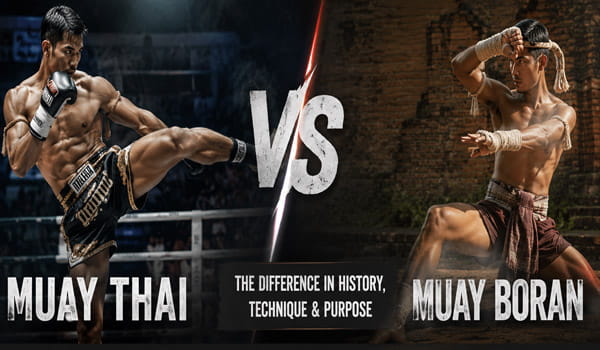
What Is Muay Thai? Muay Thai vs Muay Boran & Why It’s So Effective

If you’ve ever watched a Muay Thai fighter in action, you’ve probably noticed that this isn’t your average martial art. Known as the “Art of Eight Limbs,” Muay Thai has a brutal reputation for a reason. Practitioners don’t just throw punches and kicks—they use elbows, knees, shins, and fists, turning their entire body into a weapon. But beyond the explosive strikes and relentless conditioning, Muay Thai holds a rich history, deep-rooted techniques, and unique training that make it one of the most powerful and effective combat sports in the world. In this article, we’re going to break down exactly what makes Muay Thai so deadly, why it’s loved by both fighters and fitness enthusiasts, and what you should know before stepping into the world of this ancient martial art. So grab a water bottle, settle in, and let’s dive into everything you need to know about Muay Thai.

0 Comments

What Is Bajiquan? Why I Still Recommend It After 8 Years of Training

After more than eight years of practicing Bajiquan, attending seminars, training with different people, and feeling its power firsthand, I still describe it in very simple terms: Bajiquan is fast, direct, explosive, and remarkably powerful at close range. I have practiced other Chinese martial arts, but Bajiquan has always felt different to me. It does not need a large amount of space to express power, and when the body mechanics begin to work correctly, the force can arrive much faster than people expect.   My interest in Bajiquan, however, started long before I understood any of that. It began when I was a child watching martial arts movies. Like many kids growing up around Chinese martial arts culture, I did not know the difference between real training and movie choreography. I only knew that certain movements looked different. Some martial arts appeared light, flowing, or acrobatic. Bajiquan looked as though someone had suddenly driven his entire body through another person.

0 Comments

Everything You Need to Know About Ba Gua Zhang

 Baguazhang is distinctive because its philosophy of change is not merely something written beside the martial art—it is built into the training method. Circle walking, palm changes and continuous turning force the practitioner to deal physically with balance, direction and adaptation.  Its history contains both documented teachers and traditional stories. Its lineages don't all practice the same Eight Palms. Its martial techniques are broader than the name “palm” suggests. And its value today doesn't depend on pretending we still live in Qing-dynasty Beijing.  Sometimes the old lesson is useful precisely because modern life looks so different.  Keep your center. Watch what's changing. And when pushing straight ahead stops working, learn how to change the angle.

0 Comments

Advanced Combat Techniques: Understanding Vital Organs and Joints

Picking up from where we left off, we continue to explore the role of the hip joint in technical movements. I will introduce two types of force exertion in the hip joint: thrusting and rotating. Let's use the "Push Thrust" move from boxing as an example to explain the thrusting force.        In boxing, the Push Thrust is a basic takedown technique. Unlike the pushing actions in self-defense videos online, the Push Thrust requires the explosion of full-body strength, propelling forward while the hands carry and then thrust forward vigorously.       This move is somewhat akin to the Tiger Pounce in Xingyi Quan, resembling the pounce of predators like wolves and tigers during a hunt. Note that once executed, this move is almost impossible to counter. Here, I advise against retreating to absorb the impact and then trying to counter with an over-the-shoulder throw, as that might send you flying even further.    Now, let's break down the Push Thrust. First, the front foot steps forward, allowing sufficient space for force generation. Then, the back foot pushes off the ground, driving the whole body forward, and the hip joint thrusts forward, powering the upper body to lean forward and push with the hands. This move can also be combined with the "Catch" technique, grabbing the opponent's shoulders to complete the movement. When ensuring an effective attack that the opponent can't dodge, this move can directly knock down the opponent.

0 Comments

San Da: the front hand straight punch.

 In this article, I will explain the most basic and commonly used punch in Sanda: the front hand straight punch.      In the realm of combat, the front hand straight punch mainly comes in two types: one involves turning the front foot (this type of front hand straight punch is often intended for direct strikes, causing damage to the opponent with strong lethal power).         The second type does not involve turning the front foot. Compared to the first type, this front hand straight punch has weaker lethal power, but it is more effective in connecting subsequent actions. Its primary use is for probing the opponent, measuring the striking distance, scoring points, and linking subsequent actions for combination attacks (such as a front hand straight punch followed by a back hand straight punch, or a front hand straight punch followed by a throwing technique).

0 Comments

How a Taoism Practices

I perform this practice once upon waking and once before sleeping. If time allows, I also do it in the afternoon. The duration is flexible. I approach the practice slowly and naturally, without focusing on appearances or controlling my breathing. I close my mouth slightly with my teeth lightly touching and my tongue resting against the roof of my mouth. I sit straight with an erect spine, relaxed shoulders, and a contained chest. My eyes are nearly closed (as if lowering a curtain). I place both hands lightly on my lower Dantian in the Taiji symbol posture. Either crossed-legged or in a natural sitting position is acceptable. I breathe out turbid air from my mouth and then slowly inhale fresh air through my nose, replenishing the air expelled from my Dantian. I exhale quickly and inhale slowly, fully exhaling and inhaling. I repeat this breathing three times to expel all turbid air from my abdomen, then settle my mind, putting all thoughts aside. I redirect my vision and hearing inward, concentrating the essence in my kidneys, guarding my eyes, the soul in my liver, guarding my mouth, the spirit in my heart, guarding my nose, and the thoughts in my spleen, with concentrated intent.

0 Comments