Embracing the circle and maintaining unity, from Wuji emerges Taiji, and from Taiji returns to Wuji, from nothingness comes existence and returns to nothingness. The whole body relaxes, each joint seamlessly connected. By adapting to the opponent’s immense and abundant force, bending when necessary and extending when possible, against rigidity I remain soft, I follow when the opponent resists, rendering their relentless assault ineffective, graceful as bamboo swaying in the wind, using softness and flexibility to remain stable under fierce attacks.
“The way that can be told is not the eternal Way; the name that can be named is not the eternal Name.” All lies within the natural shifting and handling of Taiji, where movements reveal agility within stability, embodying the boxing classic’s saying, “Let him bring forth all his strength to attack me, I only redirect a fraction to control his might,” utilizing minimal force to overcome great strength, achieving softness overcoming hardness through evasion and engagement.
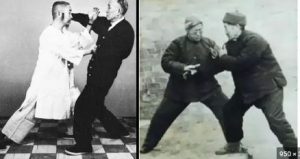
Surrounded by myriad challenges, I remain unshaken! Facing relentless aggression, leveraging the soft and boneless Yin gestures to deflect and neutralize force, advancing and retreating, drawing circles to adhere, stick, follow, and also circle, small circles within large circles, large circles encompassing small ones, drawing arcs that dazzle like celestial maidens scattering flowers.
Thus, the essence of Taiji Push Hands is encapsulated in the concept of the circle, drawing circles and arcs in every movement, embodying Yin and Yang, embodying Taiji, creating a natural law of receiving and following! In Taiji Push Hands, every motion draws arcs, receiving to respond, using compliance to control, achieving the purpose of controlling through compliance.
A single hand traces arcs in the air, navigating around the opponent’s attacks with softness overcoming strength, not resisting the opponent, but allowing their force to dissipate within the circle, leading it to emptiness. When an unparalleled punch comes, one should slightly turn the body, with the right hand lightly touching the opponent’s arm, then with a coiled waist, suddenly flick the wrist, pushing the opponent away.
The hidden marvel of Push Hands lies in the intention set by the waist gap, then gathering into the bones for the enjoyment of circular movements. Silk reeling energy must sink qi to the Dantian, suddenly exerting force from the waist, the effect depending on the accumulation of daily practice. When used effortlessly, the smooth flow of movements brings a deeply satisfying sensation.
The essence of Taiji Push Hands lies in its lightness and softness, suddenly exerting force from the waist and abdomen, driven by the spine to rotate the arms, reaching the fingers. One hand coils inwardly from the arm, turning the little finger to hook the opponent’s wrist, while the other hand coils outwardly, turning the thumb to exert force, entangling the opponent’s entire arm. Finally, a move resembling the shifting of stars embraces the circle, launching the opponent from the ground into the air.
Soft against rigidity signifies movement, compliance against resistance signifies adherence! In Push Hands, transitioning between advancing, retreating, and folding is essential. With half-circle leading to another half-circle without fully neutralizing, keeping everything under control, as if a small boat in the vast sea remains stable amidst the waves.
“As it extends, it seems taller; as it descends, it seems deeper; advancing, it seems longer; retreating, it seems shorter.” To truly advance in the vast realm of Taiji, one must master the concept of leading into emptiness, as the Taiji boxing classics say, “If left is weighted, then left is empty; if right is weighted, then right is faint.” Standing upright and peaceful, supporting all directions, moving as if threading nine pearls, the great Way flows like water.
